

An Introduction to Generative Artificial Intelligence for Academics
About this paper:
- Nate Breznau and Hung H. V. Nguyen published this review article in F1000Research in 2026 as version 2, volume 14, article 655.
- Written for students, teachers, researchers, and academic staff without a computer science background, it introduces the foundations of generative AI, ethical concerns, research-support tools, and practical prompting strategies.
- Its central implication is that generative AI should be treated as an assistant requiring verification and accountability rather than as an authoritative source, leaving critical judgment and responsibility with the human researcher.
Introduction
Generative AI is becoming part of nearly every stage of academic work, including literature searches, summarization, coding, data analysis, translation, and course-material preparation. A survey of German university students cited by the authors reported that the proportion using generative AI rose from 63 percent in 2023 to more than 90 percent in 2025. The paper therefore begins from the position that deciding whether to use generative AI is no longer enough. Understanding what these systems can do—and what should not be trusted without verification—has itself become an academic skill.
This article should not be read as a conventional empirical study. It does not introduce a new model or test a hypothesis through a controlled experiment. The authors describe it as a semi-informal introductory review, closer in style to a lecture or course. It combines academic literature, popular sources, and the authors’ practical experience to give non-specialists a broad conceptual map. Claims about the performance of particular tools and predictions about their future should therefore be distinguished from findings established through systematic evaluation.
Version 1 was first published in July 2025. Version 2, published in February 2026, responds to peer-review comments. The revision adds references supporting explanations of how AI works, connects the ethics discussion more directly to FAIR principles, explains the authors’ rationale for selecting tools, supports the discussion of politeness in prompting, identifies the source of Figure 2, and improves wording throughout. Version 2 received approval from both reviewers.
The paper develops its discussion around four questions:
- On what basis does an AI system generate an answer?
- What ethical principles and forms of human oversight are necessary in academic work?
- What kinds of tools can assist literature discovery and data analysis?
- How should a prompt be structured to produce a useful and assessable output?
This order is significant. The paper establishes the limitations of generation first, sets out principles of responsibility second, and only then discusses tools and prompting. Effective AI use, in this framing, is not equivalent to maximizing how much work is delegated to AI.
Main Discussion
Generative AI “knowledge” is pattern prediction, not comprehension
The paper explains artificial neural networks (ANNs) as the foundation of mainstream generative AI. An ANN passes inputs through layers of connected nodes and combines a large number of learned weights to calculate an output. Before training, randomly initialized parameters do not produce useful predictions. During training, the parameters are repeatedly adjusted to reduce the difference between the model’s output and the expected output in the training data.
The central mechanism is backpropagation. The model first calculates the error between a prediction and its target. It then propagates information about that error backward from the output side of the network, estimating how each parameter contributed to the result. An optimization algorithm uses these estimates to update the weights in a direction that reduces the error. Learning consists of repeating this process across a very large volume of data.
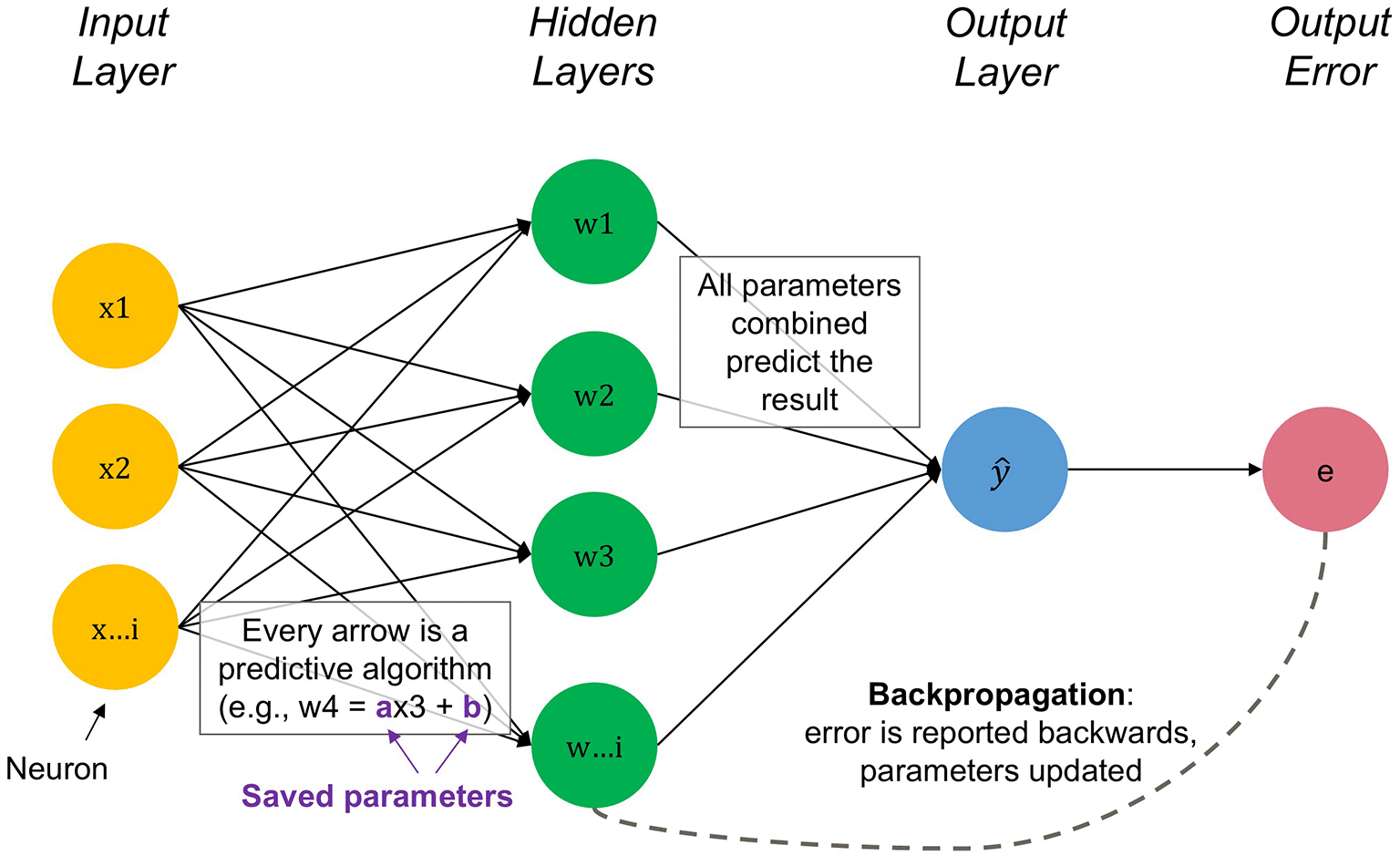
Figure 1. A conceptual diagram of an artificial neural network and backpropagation. Source: Breznau & Nguyen (2026), Figure 1, CC BY 4.0.
Figure 1 reduces this process to four components:
- The yellow nodes on the left represent inputs $x_1, x_2, \ldots, x_i$.
- The green nodes represent intermediate computations in hidden layers, with trainable parameters associated with the connections.
- The blue node $\hat{y}$ represents the prediction produced by combining those intermediate computations.
- The red node $e$ represents output error, while the dashed arrow shows the error being reported backward so that parameters can be updated.
The important idea is that information moves in two directions. A forward pass transforms the input into a prediction; backpropagation uses the resulting error to calculate parameter updates. A real Transformer or large language model is vastly more complex than this diagram. Figure 1 is therefore best understood as a conceptual illustration of the prediction–error–revision cycle, not as a literal map of a modern generative model.
The authors distinguish the outcome of this training process from human semantic understanding. What appears to be model knowledge is a statistical compression of relationships repeatedly observed in training data. An image model, for example, does not understand a cat as a person does. Its parameters have instead been adjusted so that particular combinations of edges, colors, and shapes produce a high probability of the label “cat.” Fluent output does not give the model an internal fact-checking mechanism that guarantees truth.
Language models calculate distributions over tokens
A large language model (LLM) is an artificial neural network designed to process language through the Transformer architecture. The paper usefully distinguishes the two concepts: all contemporary LLMs are ANNs, but many ANNs process images, biological sequences, or other non-language data and are not LLMs.
An LLM does not read a sentence as the same sequence of words perceived by a human reader. It first divides the text into tokens, which may be complete words, parts of words, spaces, or punctuation. Each token is converted into a fixed-length numerical embedding. An attention mechanism then assigns dynamic weights to relationships between tokens, allowing the model to use the surrounding context when calculating a probability distribution for the next token. Repeating this selection produces text that appears coherent at the word, sentence, and paragraph levels.
The paper describes three broad Transformer configurations:
- Encoder-only models use bidirectional context and are suited to tasks such as classification or reconstructing masked input. BERT is the standard example.
- Decoder-only models generate a next token from preceding tokens. GPT models and most conversational generative AI systems use this configuration.
- Encoder-decoder models separate input representation from output generation and are commonly applied to input-to-output transformations such as translation.
A foundation model is first pre-trained on broad data. Instruction tuning and reinforcement learning from human feedback can then make it more responsive to user instructions and conversational norms. External tools, such as web browsing, Python execution, or image generation, extend the system beyond text generation. An AI agent goes further by planning a multi-step task, invoking tools, observing results, and deciding what to do next.
This architecture helps explain why hallucination is not merely an accidental software defect. The base objective is to generate a plausible continuation, not to prove that a statement is true. When evidence is sparse or a prompt is ambiguous, a model may still produce a statistically plausible answer instead of acknowledging uncertainty. Search and code-execution tools can reduce some errors, but weak search results or inappropriate tool use can also reinforce a convincing mistake.
Capability must be separated from reliability
Because generative outputs are probabilistic, fluency and accuracy require separate evaluation. The paper cites the case of a legal brief containing fictitious precedents as a clear example: professional style can conceal false content. Models can also reproduce or amplify social biases present in historical training data, while attempts to compensate for bias through fine-tuning may introduce a different form of factual distortion.
A model’s base knowledge is also bounded by its training cutoff. Web-search tools may supply newer information, but the presence of a search function does not complete the verification process. A researcher must still confirm that a cited source exists, that it is appropriate for the question, and that the model represents its argument accurately.
The paper’s central principle follows from these limitations. Any generative AI response may fall somewhere between complete nonsense and a logically robust statement. It can be used as a starting point, but it should not be accepted as a final authority without inspection.
Research ethics: AI cannot assume responsibility
The authors reject the All-in-One AI myth: the belief that one general-purpose model is the best tool for every task. Conversational models, scholarly search systems, and statistical software serve different purposes and offer different levels of transparency and reproducibility. A general model may help generate ideas, while a systematic review requires specialized databases and search procedures, and reproducible statistical work requires software whose code, versions, and execution environment can be controlled.
Human oversight is not merely a final proofreading stage. If AI-generated analysis or text enters a research product, the researcher must assess its logic, facts, citations, and code as rigorously as work completed directly. The article strongly advises against copying AI output into public scholarly work. An AI-generated outline or example may be useful, but the researcher should understand it and rewrite the material in their own words. A model cannot qualify as an author or accept responsibility for an error; responsibility remains with the person whose name appears on the work.
Transparency is equally important. Researchers should disclose AI use when required by journal or institutional policy. If an AI system summarizes a paper, the original paper—not the model—remains the source that should be read and cited. Since the training corpus and internal generation path are usually opaque, tracing a claim back to a verifiable source is essential.
The paper discusses several forms of misuse:
- generating nonexistent sources and citations at scale;
- presenting synthetic survey responses or deepfakes as research evidence;
- using AI to p-hack until a desirable statistically significant result appears;
- offloading critical reading and knowledge acquisition to the point of losing subject competence;
- training future models increasingly on synthetic material, contributing to model collapse.
Cognitive offloading is not inherently harmful. Delegating repetitive work can leave more time for problem formulation and interpretation. The danger begins when researchers delegate work that they cannot inspect. A person who does not understand R cannot reliably judge whether AI-generated R code implements an appropriate analysis, even if the script executes without an error. The relevant criterion is not convenience but whether the user can explain, verify, and accept responsibility for the result.
Privacy and confidentiality create another boundary. Data entered into a web service leave the local device and are transmitted to external infrastructure. The authors discuss locally running open-weight models as one possible solution for sensitive material. Local execution can keep data on the device, but the smaller models available to ordinary users may be less capable, and the surrounding tools often require manual configuration. Privacy, capability, and operational complexity must therefore be balanced rather than treated as simultaneously solvable by a single product.
Research tools are easier to evaluate as finders and connectors
The paper surveys general-purpose services and specialized scholarly tools available at the time of writing. Its Table 1 reflects product information as of December 1, 2025. Product features and subscription plans should therefore be treated as dated examples. The more durable contribution is the functional distinction between types of research support.
First, a finder converts a natural-language question into a scholarly search, retrieves relevant papers, and may summarize their findings. Semantic Scholar, Consensus, Elicit, and ORKG Ask are among the examples. Some systems use retrieval-augmented generation, retrieving real records before generating a response, which reduces the risk of invented references. Coverage limitations remain: databases may omit paywalled work, non-English publications, or literature from less-indexed disciplines.
Second, a connector begins with one or more seed papers that the researcher already considers important. It then identifies other work through citation relationships or semantic similarity. Connected Papers, Local Citation Network, Inciteful, and Research Rabbit illustrate this category. Such systems can reveal related work that uses different terminology or trace predecessors and successors of an idea.
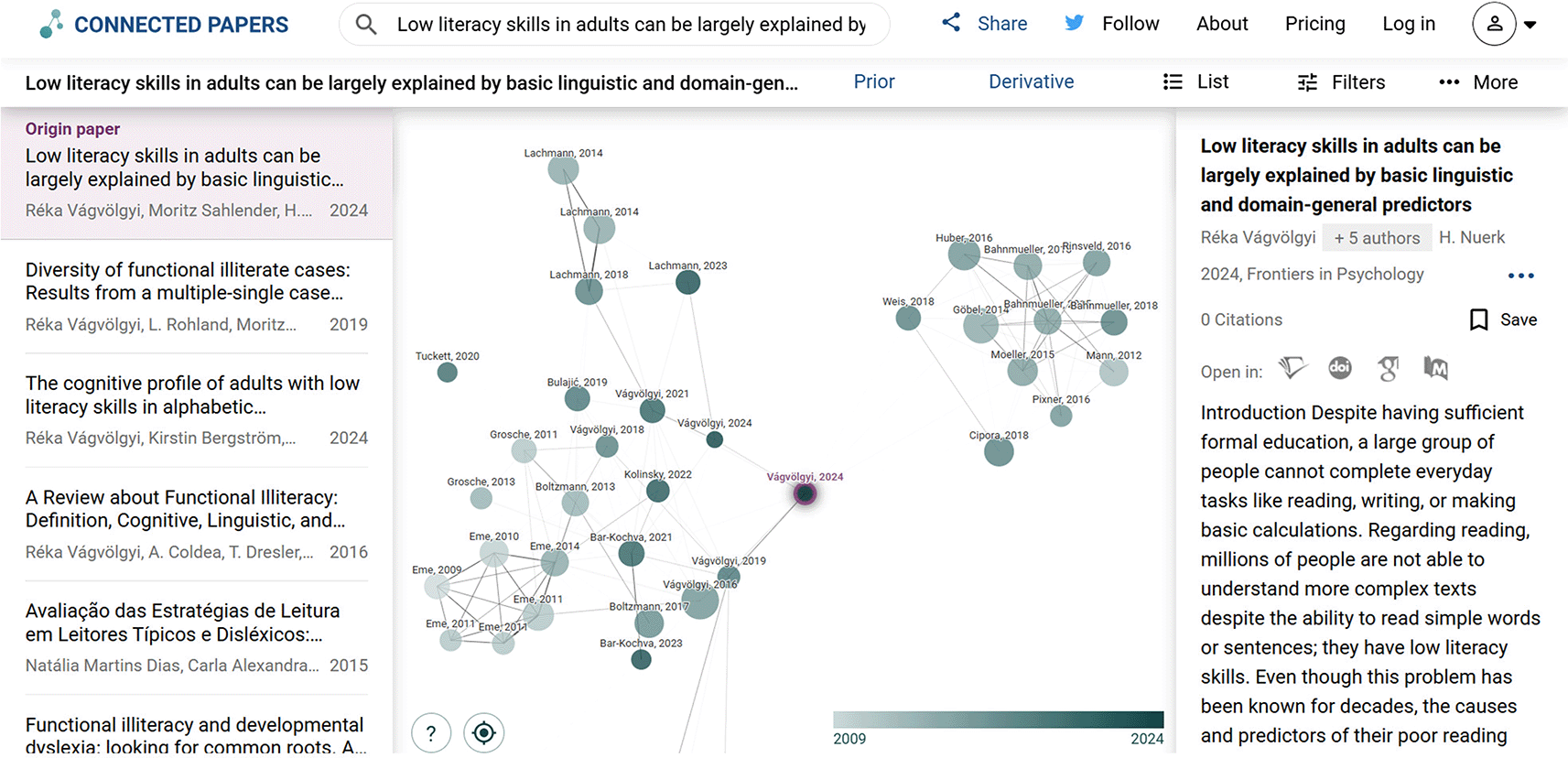
Figure 2. An example literature network generated by Connected Papers. Source: Breznau & Nguyen (2026), Figure 2, CC BY 4.0.
In the central graph of Figure 2, each circle represents a paper and each edge represents a relationship based on citation patterns and topic similarity. The highlighted origin paper serves as the starting point. Dense groups suggest related strands of literature, while papers linking clusters may offer routes between topics that use different terminology. Node color corresponds to publication year, making broad temporal patterns visible.
The graph’s value lies in presenting a research landscape rather than a flat list of search results. Proximity, however, does not measure research quality or agreement. A closely connected paper may use a weak design, and a citation may be critical rather than supportive. The visualization helps decide what to read; it does not replace reading or evidence appraisal.
Data-analysis support should be judged by reproducibility
The article discusses possible uses of generative AI for power analysis, data extraction, code generation, quantitative analysis, text annotation, and synthetic training-data expansion. The authors also report that code generation tends to perform better for Python and R than for less widely documented statistical software.
The status of these claims matters. Statements that generative AI is highly accurate in mathematics or particularly capable at a given analysis are based largely on practitioner experience and cited examples, not on a systematic benchmark conducted in this paper. A real research workflow should independently test the following:
- whether the input data and preprocessing steps are correct;
- whether generated code expresses the research question and statistical assumptions appropriately;
- whether package and runtime versions are recorded;
- whether another person can reproduce the result from the saved inputs and code;
- whether text annotation contains systematic error affecting particular groups.
The internal model and execution environment of a conversational service may not be fully disclosed or stable. A chat transcript stating that an analysis was performed is not by itself a reproducible method. The code should be saved independently, preprocessing documented, package versions and random seeds recorded, and important results checked by a human who understands the method.
A prompt is a testable task specification, not a magic phrase
The paper defines prompting as specifying a task through the input without changing the model’s code or parameters. The transferable lesson is not to memorize special incantations but to write a clear task specification.
The authors organize their advice around four questions:
- What is the task? Identify the central operation, such as translation, summarization, comparison, or analysis.
- What should the output look like? Specify length, structure, tone, audience, and file or document format.
- What context and examples are necessary? Supply the source material, data, constraints, and examples that the task depends on.
- How will the result be refined? Treat the first answer as a draft, inspect errors and omissions, and revise the request iteratively.
An underspecified prompt tends to produce a generic answer. “Explain regression” supplies much less direction than a request that defines the audience, mathematical level, example data, and expected output. When several operations are required, numbering the tasks can prevent separate requirements from blending together.
The paper also discusses few-shot prompting and role assignment. Examples can communicate a desired form efficiently, while a role can influence tone and perspective. A role instruction does not, however, confer genuine expertise. Asking a model to “act as a statistician” may shape its response, but it is not a substitute for statistical validation.
An extended example develops research ideas for applying generative AI in adult education. The first prompt simply requests ideas. Later iterations constrain the number of ideas, explanation length, and application setting, then request risks and research questions, and finally require supporting literature. Even the polished output contains unresolved problems: the source of an image is unclear and the requested citation format is not followed. The authors deliberately retain these errors to demonstrate that a plausible-looking result still requires verification and further revision.
The paper also discusses entering a temperature value in a prompt and reducing polite wording to influence output quality. Such effects may vary by model, product interface, and version, so they should not be treated as universal rules. The more durable lesson is to state requirements clearly, inspect the evidence, and evaluate the result iteratively.
Conclusion
The article connects the technical foundations of generative AI to the practical responsibilities of academic work. Its most important link is the claim that a model is a pattern-based prediction system rather than an understanding subject. Once that premise is accepted, fluent error, hallucination, persistent bias, and the need for human verification can be understood as parts of the same problem rather than as unrelated exceptions.
The paper’s principal strength is accessibility. It connects ANNs, tokens, attention, fine-tuning, tools, and agents without requiring a computer science background, then relates those concepts directly to scholarly responsibility. Figure 1 clarifies the prediction-and-revision cycle of training; Figure 2 shows how citation networks can supplement keyword searches. The recommendation to choose tools by function—finder, connector, or analysis assistant—also remains useful even as individual product names change.
Its limitations follow from its breadth and article type. This is neither a systematic review nor a model-performance study. Several technical mechanisms are necessarily simplified, product comparisons are time-bound, and some evaluations rely on the authors’ practical experience. Legal interpretations, pricing, product functions, and model performance can change rapidly. Statements such as AI being nearly perfect at mathematics or automated systematic reviews becoming standard should be read as the authors’ assessments and forecasts rather than as conclusions demonstrated by this article.
My central takeaway is that the scope of verification should be defined before the scope of AI use. Delegating repetitive work that I can understand and reproduce can extend my research capacity. Delegating sources, code, analytical assumptions, and interpretation that I cannot inspect may increase speed while weakening accountability. Using generative AI well therefore means limiting each tool to an appropriate role, questioning its output, and retaining final judgment rather than maximizing the amount of automatically generated work.
댓글남기기