

Are Emojis Really a Universal Language? Emoji Language and Emoji Translation
This paper:
- is a research article by Vanessa Leonardi, published in Language and Semiotic Studies 8(3) in 2022;
- reviews the history and communicative functions of emoji and compares emoji translations of songs, political speech, and literary classics to ask whether emoji can operate as an independent language and a universal medium of translation;
- concludes that emoji are used worldwide but are not interpreted uniformly across cultures, contexts, sequences, and platforms, making the intended meaning difficult to recover without verbal support or an added grammar and dictionary.
Introduction
Emoji are fast and economical in digital conversation. They add emotion to sentences whose tone cannot be heard, replace words with pictures, and let speakers of different languages react within the same interface. Because of this reach, emoji are often described as the lingua franca of the digital age.
Yet being used around the world is not the same as being understood in the same way around the world. A smiling face may communicate happiness, but it can also signal irony, hedging, or concealed discomfort. A hand gesture can acquire sharply different meanings across cultures, while the design of the same emoji can create different impressions across operating systems and services. If emoji were a universal language, readers would need to recover broadly similar meanings despite these differences.
Leonardi connects this gap to translation. Translation is not simply the replacement of one word with another sign. It negotiates meaning between languages, cultures, audiences, and worldviews. Does replacing the words of a source text with emoji therefore constitute a translation? More importantly, can a reader perform a reliable back translation from the emoji sequence to the original message?
This article is not a controlled experiment or a large-scale corpus study. It reviews the history of emoji and prior research, then develops its argument by closely reading well-known emoji translation projects. Its contribution is therefore not a numerical estimate of emoji-translation accuracy. It is a framework for distinguishing universality of use from universality of interpretation.
Main discussion
Emoji do more than decorate a sentence
The paper distinguishes several communicative functions of emoji.
- Expressive function: directly displays an emotion such as happiness, sadness, or anger.
- Interpretive function: acts as a tone modifier that can make the same sentence seem friendly, playful, frustrated, or sarcastic.
- Emphatic function: intensifies a message through a heart or repeated symbols.
- Referential or substitutive function: replaces a word, as when a heart stands for love or a cup stands for coffee.
- Decorative function: contributes mood and visual rhythm without adding an explicit proposition.
The important point is that an emoji’s meaning is not fixed inside the symbol. The same sentence about repairing a house can read as a serious complaint, a joke, or resignation depending on the face added after it. Emoji can reduce ambiguity, but irony and sarcasm can also create new ambiguity. Words constrain the range of interpretations when emoji supplement them; possible meanings multiply when the emoji must stand alone.
From typographic faces to Unicode
Leonardi presents modern emoji as part of a longer effort to express faces and feelings through visible marks. An 1881 issue of the American magazine Puck printed faces composed of punctuation as “typographical art.” In 1982, Carnegie Mellon computer scientist Scott Fahlman proposed :-) and :-( to distinguish jokes from serious posts. Kaomoji became popular around 1986; forms such as ^-^ could be read upright and tended to place more expressive weight on the eyes than Western emoticons did.
Emoji in the current sense began with Shigetaka Kurita’s set of 176 12×12-pixel characters for NTT Docomo’s i-mode service in 1999. Apple added a set of 471 for the Japanese market in an iOS update in 2008 and later enabled emoji globally. The Unicode Consortium then standardized a shared repertoire that could be transmitted across platforms. The later expansion of skin tones, occupations, gender representations, and foods shows that emoji are both a technical standard and a field of social representation.
Standardizing transmission does not standardize meaning. Unicode can determine which code point is sent, but it does not fully determine how each platform draws the character or how each culture interprets it. This distinction is central to any claim that emoji are universal.
A language needs combination rules, not only a vocabulary
Vyvyan Evans has argued that the reach of emoji exceeds even that of English and described it as the first truly universal form of communication. Leonardi separates a widely distributed inventory of signs from an independent language system. Language has meaningful units, but it also has grammar: shared rules for combining those units to communicate simple and complex ideas intelligibly.
Emoji sequences do show tendencies. Users may arrange them in an agent-patient-action order or follow the SVO or SOV pattern of a spoken language they already know. The problem is that users do not apply one consistent system. As sequences grow longer, they tend to resemble linear arrangements motivated by the concepts depicted rather than expressions governed by a complex grammar. Emoji-only strings also lack shared mechanisms for consistently marking tense, scope of negation, modification, and the relationship between subjects and objects.
Cultural idioms make the problem visible. A sequence involving a bomb and a bikini may evoke the English expression bombshell bikini for an English speaker, but the same pictures do not transmit that idiom to someone who has never learned it. The sign can cross a border without carrying all the cultural knowledge needed to interpret its combination.
Mixed emoji translation succeeds because words resolve ambiguity
The first translation examples in the article are an emoji rendering of Britney Spears’s Toxic and The Guardian’s emoji version of Barack Obama’s 2015 State of the Union address. Both retain some words while replacing salient nouns or actions with pictures. Bracketed explanations or interactive glosses clarify unfamiliar symbols.
These mixed texts are relatively easy to read, but their success does not demonstrate that emoji are self-sufficient. Verbal context, prior knowledge of the song or speech, and explicit glosses narrow the range of possible meanings. Emoji function as a supporting channel for emphasis and engagement rather than as the whole translation.
Emoji Dick: a translation that needs the source text beneath it
Fred Benenson’s Emoji Dick is an early large-scale rewriting of Herman Melville’s Moby-Dick. Beginning in 2009, Amazon Mechanical Turk workers produced three candidate translations for each sentence, while another group voted on the version to include. The 736-page work was released in 2010 with each emoji sequence printed above its source sentence.
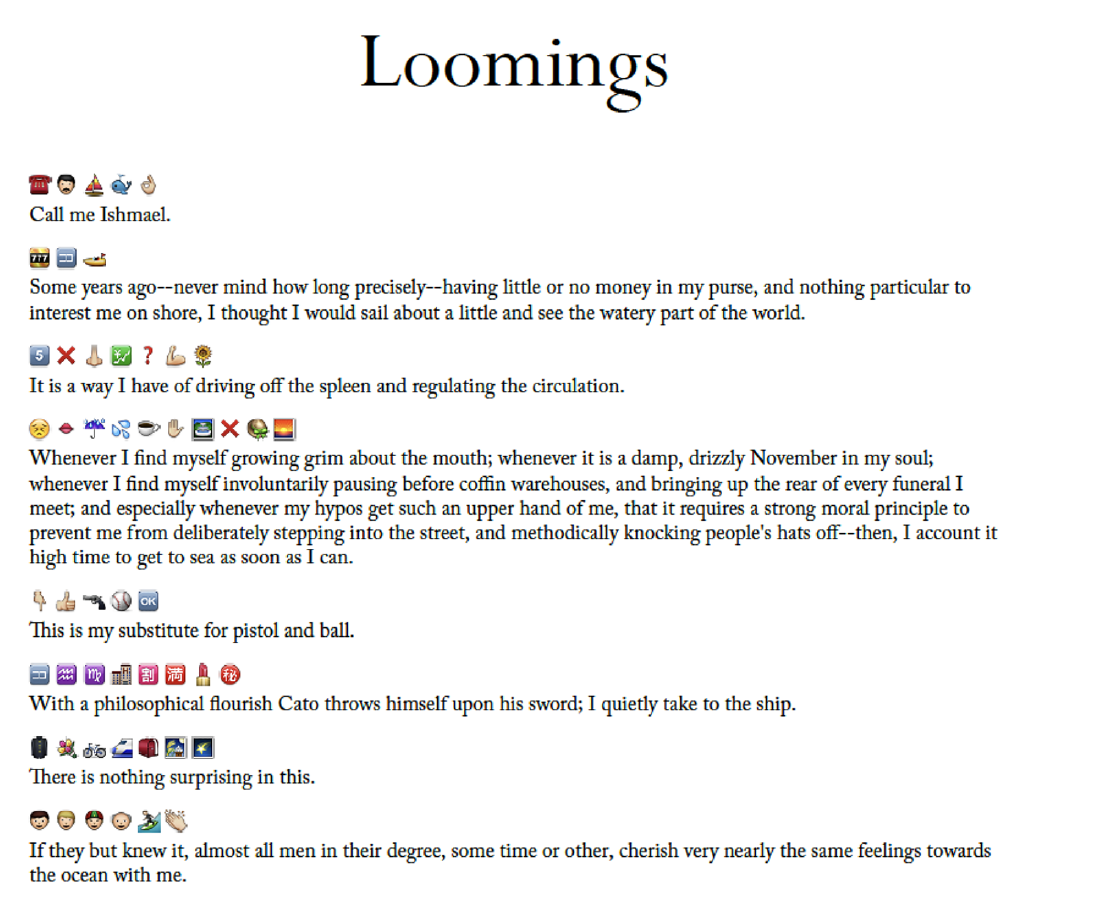
Figure 13. An extract from Fred Benenson’s Emoji Dick. Source: Leonardi (2022), Figure 13, CC BY 4.0.
The telephone in the first sequence can evoke “Call,” but it also introduces a conspicuously modern object into an 1851 novel. The remaining face and gestures do not allow a reader to derive the proper name Ishmael. Longer paragraphs are compressed into roughly ten emoji, making it extremely unlikely that a reader who cannot see the words will reconstruct the same English sentence.
This is a problem of non-invertibility. A source sentence can inspire an emoji sequence, but the sequence does not determine one source sentence in return. If the reader must already know Moby-Dick or consult the sentence immediately below the pictures, intelligibility comes from prior knowledge and the parallel source text rather than a universal emoji code.
Emoji-only translation remains difficult even with narrative context
Joe Hale’s 2015 Wonderland poster represents the whole of Alice’s Adventures in Wonderland with more than 25,000 emoji and no verbal text. It offers the article’s most demanding test of an autonomous emoji translation.
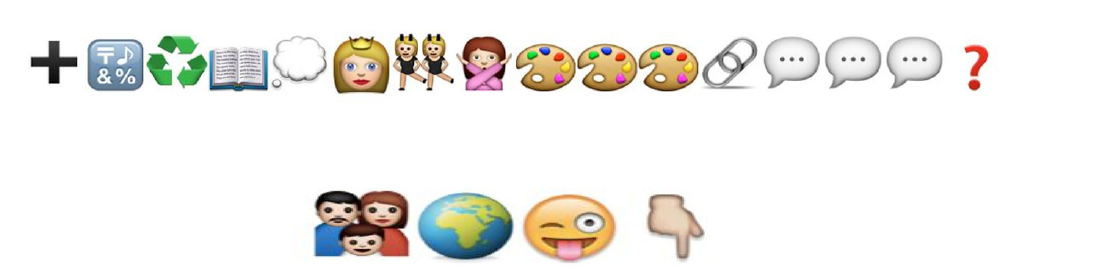
Figure 18. Two emoji combinations from Joe Hale’s Wonderland. Source: Leonardi (2022), Figure 18, CC BY 4.0.
According to the paper, the upper sequence represents Alice wondering what use a book is without pictures or conversations; the lower one represents the claim that everyone is mad. Once the intended sentence is supplied, a reader can invent links between some of the symbols and words. Producing that sentence first, without the answer, is much harder. Even knowledge of the story does not establish who is speaking, how far the question or negation extends, or which grammatical relation connects the faces and objects.
Kristina Semenova’s A Christmas Carol and other books in the Vaikon series take a hybrid approach, combining words and emoji and adding a rebus dictionary. This support helps, but some combinations still depend on detailed story knowledge and the maker’s code. A captain paired with a crying face, for example, is intended to mean chief mourner. Because the same emoji can represent different words in different sequences, readers must move among the text, dictionary, and original story.
Pinocchio in Emojitaliano: rules improve readability but remove universality
Francesca Chiusaroli, Johanna Monti, and Federico Sangati’s 2017 Pinocchio in Emojitaliano takes a different approach. It codifies emoji combinations around Italian grammatical and syntactic rules and provides the Italian source, emoji translation, grammar guide, and glossary. A Telegram bot was also used to build the shared emoji dictionary.
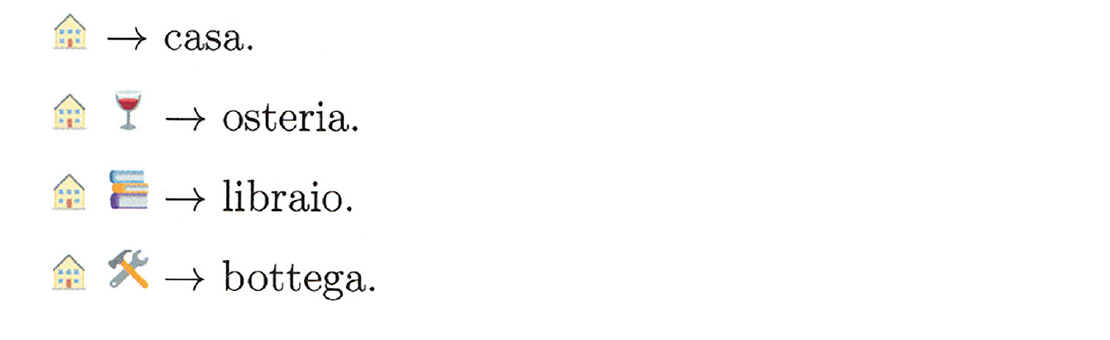
Figure 19. The compositional glossary in Pinocchio in Emojitaliano. A house means casa; house+wine means osteria; house+books means libraio; and house+tools means bottega. Source: Leonardi (2022), Figure 19, CC BY 4.0.
The system combines a house with a wine glass to mean an inn, with books to mean a bookshop or bookseller, and with a hammer and spanner to mean a workshop. It also uses grammatical operators: placing a left arrow after a snail can transform the adjectival concept slow into the adverb slowly. The project is not simply substituting one picture for one word; it expands the lexicon through conceptual combinations.
Rules and a dictionary make the translation more decodable, but readers must identify each group, consult the glossary and grammar guide, and then return to the sequence. Decoding even one example requires finding the snail, determining the arrow’s grammatical function, and reinserting the result into the sentence. A children’s story becomes a slow and demanding decoding exercise even for adults.
This produces an important paradox. Making emoji readable as a language requires a grammar and dictionary, but these rules are modeled on Italian. The codification that improves decodability weakens the claim that emoji are language-independent and universal. Emojitaliano is an inventive semiotic system, not a world language that everyone can read in the same way without passing through Italian conventions.
What the article demonstrates—and what it does not test
The paper’s strongest move is to turn the abstract question “Are emoji a language?” into practical questions about readability and back translation. Placing mixed, emoji-only, and codified translations side by side reveals a clear tradeoff: as verbal context and dictionaries disappear, interpretations proliferate; as rules are added, reading becomes more laborious and language-specific.
The scope of the conclusions nevertheless requires care.
- The article does not report a systematic search or explicit selection criteria for its examples.
- It does not recruit readers to measure comprehension, agreement, reading time, or cross-cultural differences.
- No independent coders assess the author’s interpretations or calculate back-translation reliability.
- Platform, generation, and cultural differences are discussed through prior work rather than compared experimentally in this article.
- Treating grammar as a dividing line is useful, but it can simplify the continuum among writing, gesture, image, and meme in multimodal communication.
- The examples and much of the supporting evidence come from the 2010s, so they do not represent the complete contemporary emoji repertoire or every current usage practice.
The paper should therefore not be read as an experimental proof that emoji can never be universal. A more precise conclusion is that none of the examples demonstrates reliable recovery of the same source message by different readers without supporting context. The cases instead provide rich evidence of why that standard is difficult to meet.
Conclusion
The article’s most important distinction is between universal use and universal intelligibility. Emoji are a shared resource across most digital platforms, but their meanings are not fixed like single dictionary definitions. Cultural convention, relationship, surrounding language, sequence, and platform design jointly shape interpretation.
The translation examples reveal a three-way tradeoff. Mixing words and emoji improves readability because the words resolve ambiguity. Using only emoji increases creativity and visual play but removes information needed for back translation. Adding grammar and a dictionary makes decoding more consistent but introduces a learning cost and dependence on the structure of a particular language. Autonomy, readability, and universality are difficult to achieve at the same time.
The strength of emoji therefore lies less in replacing verbal language than in supplementing what words often leave implicit: emotion, stance, relational cues, emphasis, play, and participation. They are exceptionally efficient for short reactions and interpersonal signals. As a message requires greater factual precision, narrative complexity, or explicit grammatical relationships, it also requires more verbal language and shared context.
My main takeaway is that an emoji is not a small picture containing a complete meaning; it is an interpretive cue that asks for context. Seeing the same symbol does not guarantee sharing the same message. Better digital communication and translation begin not by declaring emoji universal, but by asking who will read them, through which cultural and platform conventions, whether enough verbal support limits ambiguity, and whether the essential meaning survives when the message is read back.
댓글남기기